Octave undertone on the A string (DAdd)
Instruments- discuss specific features, luthiers, instrument problems & questions
@spineloccio Any change in the unwanted tones your wife's McSpadden was giving?
Well, thanks everyone for the informative replies!
I do plan on attaching an end plate & nut and get it strung up! Will definitely use brass pins of some kind rather than a wood dowel.
Tung oil is an oil from the tung nut tree in Asia. Better than boiled linseed oil! Yes, it hardens. Get as pure of tung oil as you can -- some manufacturers adulterate it with other things. It works fine with stains that are dried.
Nice catch on the paper with the notes. I made that, and like everything with me, it is a bit more than 20 years old. It has also been in and out of that placement more times than I care to think about. I will double check that. Thank you Ma'am :)
Tung oil. Never heard of it. But it is something I will be looking into now. Deep gloss is nice, but not all the time. Does this "harden" at all? Also, how does it act/react with stains?
Wolf tones like that can be notoriously hard to cure. However. This is probably something that has crept in from having the instrument used -- tuned, re-tuned, changing environments, etc. Start by slacking way off and then re-tightening the middle drone string, making sure that you have a snug fit in the notches at the nut.
FWIW, since strings can be tuned to any of 8 notes in an octave, we generally refer to them by their "course name", not the note they are tuned to. The dulcimer has a Melody course, the middle drone course, and the bass course. Each course can be 1 or 2 strings.
Finish -- I'm a big fan of Tung Oil. Rub on 4 coats of tung oil and call it good! But then I don't like deep mirror glossy finishes on anything.
My wife has a McSpadden that is about four years old. The other day as she was practicing she started noticing what she thought was a buzzing string when she played the low D on the second fret. I started looking at it this afternoon, and there is no buzz when the string is played by itself. Instead, when the low D is played and the A is also played, there is an octave undertone on A. It just happens to be very obvious when the D is played on the second fret. Any ideas, please?
Um, when you are making a note of what each strings was tuned to, be careful:
I'm thinking that someone inadvertently REVERSED that paper naming the notes for each string. The notes should be going LOWER, not higher, as the strings get longer. Your slip of paper is currently oriented the opposite way. --> Try taking the paper out and putting it in the opposite way. Starting with the shortest string, it would then go: C, B, A, G, etc...
There is going to be some manner of brass used in this project. That black piece where the stings run over the courses is plastic. Sure, a hard plastic, but I think brass would be a better option. This was not a high digit instrument. But with some careful consideration, it can become mighty fine. Just need to exercise the necessary care to make sure the brass is good and straight, no kinks allowed. A soft 'bow' maybe, but that is it.
Brass would be good at the tail, but wood would look better...decisions, decisions... Either way, there should be some "shaping" to get the piece to look right.
Ah, the strings. I have done a LOT of rooting about the net on that. I do believe I have the gauges now. It is also fairly apparent that the strings are indeed ball end guitar strings. There is a place I go for my dulcimer strings that can set me up with what I need. ~L~ At that point it is choosing the correct TYPE of string. One site I looked at likened the strings to gauges of piano wire.
As a retired machinist and tool maker, I know WD-40 quite well. But using it on a tuning peg in wood? Maybe a q-tip and daubing? But a goof tip. Not one I would have considered, but it sounds like a plan.
"Make a note about the note they are tuned..." Hoboy, done. After that, there is the world of confusion that goes into all of the alternate tunings. Is Draconian an type of tuning?
Then, after all that, clean the poor baby and have a look, eh?
There WILL be sanding and refinishing. This is something I enjoy quite a lot. There are some nasty looking marks on the edge of the face that need to be addressed. Short of the playing once the work is done, the wood working part of this is going to be one of if not THE best part of the project.
The more I look at this thing the more I am convinced that the "finish" is about as minimal as it gets. "Student" instrument was mentioned. Sounds about right to me. I am leaning toward a lacquer or shellac for the finish. Needs to be water based though as I do not have good ventilation and cannot access a spray booth. Yup, spray. ~L~ I do NOT have the arms to do a French rub.
To stain or not to stain...
I want to thank you all for the ideas and suggestions. I have never worked with an instrument before. Not a decent one. I can use ALL the help I can get.
It slides off laterally. Either towards the head stock or away from it, depending on how it's orientated. Sometimes they are very tight and you need to wiggle it a little while sliding it.
My mandolin had a similar tailpiece. It was also very tight. I very carefully bent the sides out a tiny bit to lessen the tightness of the fit and it was much easier from that point on getting it off to change strings. It didn't need much, you still want a snug fit. I took it off the instrument when doing it, because you don't want to put any pressures on the other parts of the tailpiece or instrument when doing it. Again, ever so slight, not even enough to feel a movement.
Yeah, I've never experienced that before, but it is a cheap import a friend picked up at the thrift store. I adjusted the action and put on new strings.
Ken
"The dulcimer sings a sweet song."
Ken, in that case, a bit of lube is a good idea. None that I've had were ever that tight.
About the strings-I can't tell for certain, but they look like guitar-type ball end strings. (There were some oddball oversized autoharp ball end strings, but the shape of the ball end was different.) Take the strings to a well-stocked music store and you should be able to match the strings gauges for a few dollars. You might want to tape the old string to a piece of paper or cardboard and write which note they were tuned to, so you can put the right replacement on the right pins.
Fun! a worthy project.
John, I sprayed a little silcone along both side edges, but it is still holding on there. In fact, I have to put on leather work gloves and push from the bridge side of the tailpiece to tail end of the mandolin to get it off. It's not going to slide off. I can assure you of that.
Ken
"The dulcimer sings a sweet song."
Yes, that's a mandolin tailpiece. On mine, I usually lift up from the front edge of the cover to get it off, then slide it back on from the butt end of the instrument. Spring tension holds it in place. I'm not sure lubricating the contact surfaces is a good idea. You want the cover to grip the base and not slide off too easily.
You pull the top piece off. Pull it away by pulling toward the bent end which is where it attached to the instrument. You may need to turn it over and spray a little lubricant along the edges to help it out. It is meant to be tight so it does not fall off the instrument. That type of tail piece is typical of mandolins. If you need me to, I can run down to my shop and photograph one on a mandolin that I've had in for some work. I'll pull it off and show you what it looks. Let me know quickly as I'll be away Saturday and Sunday.
Ken
"The dulcimer sings a sweet song."
I agree with @paul-rappell about " the possibility of the dog flying around the car in the event of a crash." Unfortunately my Mouthymutt (malamute/husky) chewed right through a brand new harness the very 1st time, so I'm glad it's not a law here even though I'd love to do it.
He's in the narrow extended cab of our truck, a.k.a. The Fur Wagon.
Yep -- it's a kantele shape anyway, if unconventional in construction. I'd guess a "student" model.
I would start with what Ken Longfield suggests. To keep the strings from cutting into the edge of the top, I might use a thin (1/16" or 1/8") strip of wood about 1/4" wide, running across the junction of the top and back -- instead of a brass rod at the back edge as Ken suggests. Use a very hard wood -- at least as hard as hard maple -- and make sure the grain runs the length of the strip. The strip can be held in place with even rubber cement until at least a couple of strings are replaced, then string pressure will hold it.
What is that bridge made of? Metal?
I would start by recording and removing the strings, as Ken says, then a soft cloth dampened with soap water to see if those white stains and assorted crud can be wiped away. A few drops of WD-40 on each tuning pin near where they enter the wood might help things in that department.
The late Angus had a special harness that attached to a short belt that attached to the seatbelt. It's not just the dog escaping, it's the possibility of the dog flying around the car in the event of a crash.
Hi, @silverstrings! Maybe this site is what you're looking for:
No hinge, but it looks like a box lid around the edges.
The work to do doesn't seem too bad. I'd try to clean the top, back, and sides before doing any sanding. Of course I would take all the strings off before doing this. Make sure you keep a list of the gauges of all the strings in order: from high to low or low to high whichever youosr prefer. After clean up you can decide whether you need to sand the finish and refinish the instrument. You will need to see if the bridge and need any work. Although it is hard for me to see, I would probably add a brass rod all the edge of Kantele just under the top edge along the side to keep the strings from eating into the top. Keep us posted on your progress.
Ken
"The dulcimer sings a sweet song."
Alright, here is the front and back...
Hoboy yeah...needs work
James,
That looks like a mandolin tailpiece to me. If so, the pointed decorative end should lift up to reveal the string ends. In other words, there should be a hinge on the other end of the tailpiece. If it's tight, maybe dab a little WD-40 on it from a Q-tip.
My new strumstick has this tailpiece on it. How do these open? Seems like a friction fit, but it's really tight and I don't want to break anything.
I have no idea who might have made your dulcimer, but the signature looks like it could either be "N. Mills" or "Neville". Are there any dulcimer makers who fit either of those interpretations of the signature? None come to mind.
I look at it and it doesn't look as refined as those chairs, but it's an idea. His finish is definitely more "rustic", especially on the back.
Like I said, swan head armchairs and rocking chairs were made long ago in the Victorian era mostly, but then there were also reproductions of them made later on like in the 1930s-70s. The repros tend to be more simplified (less refined and less complex carving) as the original era antiques. Your dulcimer's headstock fits that style. The later repros are now of course vintage 'antiques' themselves.
@robin-thompson"> @robin-thompson said:
Lois, there is an element or two of this instrument which I've seen before-- the swan head being the more notable element. I can't recall, though, when I saw some similar photos. I'm hoping somebody knows who the maker was!
Hi Robin, you've been close enough to areas where the maker may have been. Even if it proves to be recycled furniture as Strumelia suggests, it might lead to more information.
Hmmm. Wonder who is knowledgeable about wood? We recently lost our local Native American flute maker, Don Hayes. He really knew his woods. I'll ask his widow if their son, who took the woodshop tools & wood, could tell me. I look at it and it doesn't look as refined as those chairs, but it's an idea. His finish is definitely more "rustic", especially on the back.
Showed it just now to my husband and he dared to want to improve that finish! NO!
That woodburned signature looks to me like it ends in "...ville."
~wow~
OK, let me see if I can address ALL of this! ~L~ Dang people! This has got to be about the friendliest group in Dodge!
Oh yes, I have seen Kantele' that are the size of the one in the photo. Is drooling allowed?
Full sized pics, I will work on that. File size kept being far too large.
That is certainly a VERY uncommon way to build a kantele. You may not -- in fact -- have a kantele, but rather some other form of zither/psaltery. Can we see some less close-up photos of the instrument, please? Say a quarter of the instrument in each photo. and then frame-filling pix of the top and back so we can see the whole instrument
Exactly why the name of this thread has the question mark. Maybe even a lap harp? Regardless, it is a sweet sounding instrument when it playing condition.
A computer search on Kantele was eye-opening. It reminds me of the zithers and toys that had diagrams you insert under the strings to play a song. Being eager to make music simply, I've fallen for some of those & even created some diagrams of my own. This shows there is a whole Finnish musical tradition without the cheat sheets that probably inspired the commercial American instruments .
Just wish he hadn't allowed his microphone to pick up wind noise.
Oh, I know about the wind!
Good thoughts on the tuning key. I have also thought the same about the pegs. But then, removing them and knocking down the rust with some steel wool might render something of a "patina like" looking result.
Sanding it is. That are a few seriously nasty looking dings that the moisture and iron technique are not going to touch. But then, if the patina for the pegs work out, the coloring in the dinged area might lend a bit of "old" to the appearance.
I'm not "Finnished" with mine, but appreciate seeing a more musical and traditional version.
Ooooh! PUNS! hehehee...be careful there. I too have been known to PUNish...
I just gotta add, about tuning wrenches:
Having used both the T shaped cheaper ones and the L shaped slightly more expensive ones... I urge people to get an L wrench- you get way more control for fine tuning the zither pins- the fulcrum range is much wider. Truly, it's like twice as easy to fine tune by very small increments, and also the L wrench is much much easier on the hands. It's almost like the difference in ease between plain wood tunings pegs that are sticky, and simple geared machine pegs. My advice is to pay the extra couple of bucks and get an L wrench... it'll make your life easier! ;D
Assuming a standard size guitar with around a 25" VSL, the bass "E" string is anywhere from 0.046 to 0.056. The Blue Lion bass dulcimer I play in our dulcimer group has a 27.5 inch VSL. The string gauges are 0,024, 0.028, 0.032, 0.052. All of them are bronze wound. In a set of medium guitar strings, the 4th string (D) is usually around 0.035. If you use that as your "melody" string, you can size the middle and bass appropriately.
Hope this helps.
Ken
"The dulcimer sings a sweet song."
Thanks, Ken, for that explanation of the string anchor photo. I must have been tired last night as I looked at it. I could not figure out why there would be vertical grain wood in the "nut" by the anchor pins. Now I see that is the top and the strings anchor on the side of the instrument. Duh. I just couldn't see that when I first looked at it.
Ken
"The dulcimer sings a sweet song."
@ Skip
Don't know, haven't received it yet. I would imagine regular guitar tuning.
Tuning Key -- You can use a clock key for those wind-up clocks; they come in a variety of sizes. You can use an L-shaped autoharp tuning wrench -- $15-20. Or you can get a 1/4" T-handle Tap Wrench from on-line sources ($3.99 Amazon) or a good hardware store for under $10. You want one that goes from 0 to 1/4", not one that goes from 1/4" up.
Strings -- if that is indeed how the strings are anchored you're going to need "ball-end" strings, not "loop-end"
I see what KenL means about the string anchor photo. The anchors appear to be on the rear side of the instrument and the strings are going over the edge of the top -- is that correct? I've never seen Baltic Psaltery that did not use a steel string bar on the rear deck to hold the tail ends of the strings -- as you can see in my photo below.
That is certainly a VERY uncommon way to build a kantele. You may not -- in fact -- have a kantele, but rather some other form of zither/psaltery. Can we see some less close-up photos of the instrument, please? Say a quarter of the instrument in each photo. and then frame-filling pix of the top and back so we can see the whole instrument
Oh yeah, interstate ... 70 mph, head out, ears sound like plastic tarp!
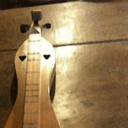
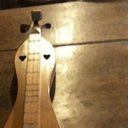
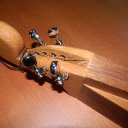
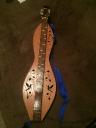
When i saw the pictures of this dulcimer, I immediately thought that the maker used the carved swan head arm from an antique chair for the head stock. Such carved swan head chair arms were fairly popular both long ago and again in later reproductions of Victorian furniture. I suspect the swan head was recycled from an old discarded chair, the rest of the dulcimer having been built at a later time than when the chair was made. In my eyes, the smooth stylized mahogany swan head doesn't really seem to match the whole rest of the instrument which is decidedly more rustic. Look at some of these vintage and antique chairs for typical carved swan head arms. One like this one could have easily been cut and adapted as a head stock. I also think the 'wing' decorative element might have come from recycled furniture, and the fretbord may have been a mahogany piece from furniture as well. I think whoever made the dulcimer was into using old furniture wood for thier projects.